The Chamber and the Cross
  • Home
  • Authors
    • Other Works & Writings
  • On Location
  • Cut Scenes
    • Carl and Paul at the White Hart Pub
    • Antique Shop
    • Kit and Laura At the Pub
  • The Inside Story
  • Links

The Inside Story - A Blog

January 22nd, 2015

1/22/2015


Scenes Should Work Hard
​- Like a College Dorm Room

Recently I visited the freshman dorms at a local university where my niece is in school. She lives in a small room about the size of the kitchen in my old apartment. Three young women are crammed in with three bunks, three desks, and ladders connecting everything floor to ceiling. One side of the room has a double bunk, and the other has a raised bunk with a desk beneath it. Visitors stand in the doorway. If you want to hang out, you have to start climbing ladders. In addition to her desk and closet, each girl has a computer, photos, knickknacks, and those plastic storage boxes purchased by helpful moms. The room works hard to meet the needs of its occupants.
When you’re writing a novel, each scene should work just as hard as a college dorm room.
When Deborah and I were trying to wrestle our unwieldy manuscript into a manageable size, we kept deleting scenes. At first we were trying to reduce word count, but that only caused trouble. We needed to build smooth transitions and cause-and-effect flow. Each scene was supposed to lead seamlessly into the next plot point, while also deepening our characters. Obviously you can’t do that if you keep throwing things away. That would be like a college freshman ditching her computer because her roommates wanted more elbow room. Writers can take a lesson from the dorms: there is a clever space for the stuff your story needs.
Every scene needs basic description, action and emotion. And then, like the desks and bunks, you add layers that do even more. Deborah and I have adopted an expression when we think a scene is shallow. We say it needs to work harder. Rather than cut it, we look for ways to build in more emotion, more actions that reveal character traits, and more details to add tension.
Whenever I don’t know what to do with a character, I send them into the kitchen. That’s my comfort zone; I know how to describe the utensils and actions. Naturally, there is a scene in The Chamber And The Cross in which Laura is cooking. The problem with the first draft was that she wasn’t doing anything but making supper. The scene wasn’t working very hard.
Deborah’s rewrite of the scene revealed a lot about herself. She added description of flow-blue china, something that she loves. For years she’s been collecting plates and platters, and her kitchen is designed to highlight the dishes on display. Clearly she likes traditional, yet homey décor.
The descriptive detail helped, but we still needed our kitchen scene to show more about Laura. To achieve that, we let the actions of cooking fade into the background, and brought another character into sharp focus. While Laura is preparing the meal, the housekeeper, Winnie, tells her stories and accidently lets slip an old family secret that adds to the tension. Through an innocent conversation, Laura (and the reader) gather important information. By adding more people, dialogue, and emotion into the same amount of space, the scene started working harder.
Deborah and I wrote multiple versions of most of our scenes. We also made some tough decisions to cut a few personal favorites. That old material reveals a lot about our process, and if you want to have a look, we’ve created a section on our webpage for CUT SCENES. Think of them like drafts of term papers that never got turned in.
Any college kid will tell you that they can always use more stuff. And experienced writers will tell you that a scene can always work harder.

November 19th, 2014

11/19/2014


Tears For Freshman Comp

This essay by Lisa Shapiro was published in the book Attachment-Based Teaching: Creating a Tribal Classroom by Louis Cozolino​
I always shed tears at funerals, weddings, or a dedication ceremony to name a baby. One other place I’m almost certain to cry is in my freshman composition class. When I first started teaching college English, I was stunned to discover how many students hated it, and their loathing of the subject seemed directly connected to past experience with the five-paragraph essay. This simple structure – an introductory paragraph followed by three body paragraphs with a topic sentence and supporting examples, and then a paragraph of conclusion – helps students organize information. As a creative process, however, it’s like spending a few hours naked in a walk-in freezer – mind-numbing to the point of imaginative hypothermia.
To rekindle the fire of inspiration, I asked my students to write narrative essays. My goal was to get them to hear their own voice – the “I” voice – which many of them had been cautioned never to use in writing. What ensued was like a reality T.V. show for freshman comp, with everyone spilling all kinds of emotional stuff; to hell with the punctuation. Then, to help students really hear their writing voice, I asked them to read their essays out loud.
This process of writing and reading seemed to draw them out, to help them connect to the class and to one another. The students also became more engaged with the content of their essays, and they seemed willing to pay a little more attention to details like sentence structure. Initially, I thought this was just a backdoor approach to essay writing, a way to get them to buy into the assignment by making it more relevant to their own experience. Gradually, however, I began to see that in addition to being more interested intellectually, the students were also more engaged emotionally, which led them to take more control of the assignment. Rather than waiting for instructions, they would often approach to ask if they could tackle a certain topic. Could they write about getting drunk, stealing, using drugs, being involved in a gang? The answer was yes – always yes. Could they use swear words? Of course. Not all of my students were rascals; some wrote about sitting in a hospital room with a parent who had cancer, and then becoming like a parent to a younger sibling. They wrote about loss and love and life, and about all the lessons they learned. At some point, the essay itself took a back seat to the topic, and it seemed to me that that was how it should be – content should dictate structure.
Something else was happening in the classroom, too, and after a while I couldn’t ignore it any longer. The essays that my students were writing were important to them, and they were important to me, and not just as a teaching tool. Their words got under my skin, wormed their way into my consciousness and into my heart. Their lessons left a mark on me, and I was learning from their experiences. I wasn’t immune to the emotional vulnerability they shared, and so the classroom was suddenly a riskier place for me to be. It caused me pain, and it made me cry.
These moments that I share with my students are as beautiful as they are painful, they impact me as much as any wedding or funeral, and they happen every semester. I know that when I walk into a classroom and students start writing and reading their stories, their lessons will open me, fracture and enlighten me. Freshman comp is one of those classes that students dread, but it’s the class where I learn the most, and I’ve come to love it, even though it makes me cry.

November 17th, 2014

11/17/2014


History and Literature - Two Great Things

When I was studying literature, I lucked out because two of my grad school professors were historians. My focus was war literature, and I steeped myself in classics. Wars can change the course of history, the trajectory of lives, and alter the essence of a human soul.

The Chamber And The Cross is not a traditional war story by any means. It is a contemporary thriller wrapped around a medieval romance. But war was a big factor in England in the second half of the fifteenth century. That’s the time period that Deb and I used as a backdrop for part of our book, and it’s worth taking a closer look at the war that wove itself through the lives of our characters.

In the fifteenth century, the Hundred Years’ War between France and England was coming to an end, and the English and their allies were being driven out of France. The war left England impoverished, and set the stage for what is sometimes called England’s civil war – more popularly known as The Wars of the Roses. The romantic name stems from the fact that the first phase of the conflict was between Lancaster and York (1455-71). Lancaster’s coat of arms features a red rose, while York’s badge has a white one.

I highly recommend Alison Weir’s The Wars of the Roses, published by Ballantine Books. It provides a fascinating, in-depth account of the entire conflict.

Also recommended is a trip to England!

A brief overview of the family dynamics that set The Wars of the Roses in motion begins with the fact that King Edward III had thirteen children, and five of his sons became Dukes.

Edward’s third son, John of Gaunt, the Duke of Lancaster, began the royal line that gave us King Henry IV, and his grandson, King Henry VI.

On the other side of the royal garden, King Edward’s fourth son became the Duke of York, and his grandson also took his title. This is where things get thorny. The Duke of York’s mom was descended from the second of those original five brothers.

Here’s a test question to keep you busy on your next pub crawl: who gets the throne? Is it the child descended from the second son, through the female line? Or is it the child from the third son through the male line?

It’s okay if you need to take notes.

The flowering lineage of the Duke of Lancaster resulted in King Henry VI. The Duke of York’s progeny were also fertile, and their line sprouted the babe who became King Edward IV. Both Edward IV and Henry VI claimed the throne at the same time, and so they had to, you know, duke it out.

The war might not have come to pass except that Henry IV (from the third son, remember?) had previously bumped out Richard II, who was really first in line, having descended from the first of those five sons. This is known as usurping, and it’s sure to sow seeds of dissent.

Our character, Lord Brian Bannock, was a Yorkist and loyal to Edward. The decisive battle between York and Lancaster came at Towton in 1461 – and Brian Bannock was there.

Happy Reading,
​

Lisa

November 10th, 2014

11/10/2014


The Human Story Of The Battle Of Towton

One of the fun things about writing historical fiction is using real places, creating a character and putting them into the flow of actual events.

And it’s a great excuse to travel.
​

During our trips to Great Britain, Deborah does the driving – she’s able to flip some kind of switch in her brain that lets her drive on the left-hand side without crashing.  I like maps, but even when I’m armed with atlases, digital apps, and the color-coded placemats made for tourists, I get lost in the parking lot.
Picture
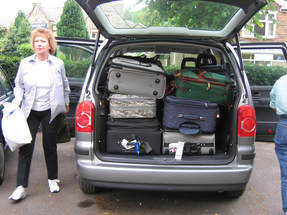
On our trip to Towton, in Yorkshire, we crowded into a van with a posse of laughing girlfriends. The second hardest thing about traveling, besides the driving, is smooshing everyone’s luggage into the back. Every morning, fortified by a lovely English breakfast, I completed the suitcase jigsaw puzzle, usually with one piece left over that had to go on someone’s lap.

Sometimes it took so long that locals wandered over and took photos. Perhaps they showed these pictures to their children with accompanying warnings about the hazards of over-eating and over-packing.

When the van was loaded more heavily than a warhorse bearing a medieval knight in full plate armour, we were off.

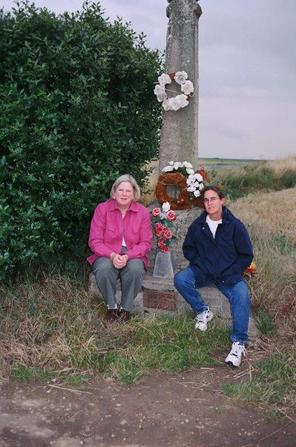
Deb and Lisa at Towton memorial
​

Towton Battlefield is one of the places where we researched The Chamber And The Cross. This particular fight to determine the king of England took place on Palm Sunday in 1461, and many historians have called it England’s bloodiest battle. It was snowing that day when soldiers loyal to the House of York faced off against those defending the House of Lancaster. Fifty thousand men clashed on what came to be known as The Bloody Meadow. By the time it was over, more than half of them were dead.

PictureDeborah and Lisa at the Towton Memorial
We got lost along the way and found the meadow just as the sun was setting. I wanted to see the river, and the footbridge over which the retreating army had fled, but the land is private, so we surveyed it from a distance. It’s peaceful, planted with potatoes, lined with trees, a single cross marker the only indication that something so historic, so momentous took place on that high ground above the village.

The sinking sun turned the surrounding fields golden, and as I stood watching the light illuminate the meadow, time became suspended. I tried to imagine troops lined up on either ridge, horses stamping the frosty ground, armies in chainmail and leather bearing bows, swords and shields. Overhead flew the standard of Lancaster with its red rose, and the white rose of York. I breathed in the soft, mild air of late summer, and imagined the damp, wet chill of England’s spring.

Many of those killed that day were buried in a mass grave that was discovered in 1996. One of the characters in our book is a forensic anthropologist who helped recover the skeletons found at Towton. Another of our characters fought in the battle. Before we set out to tell our story, the stories of those who lived and died in the Battle of Towton had already been woven into the red and white tapestry of the Wars of the Roses.

That day as the sun was going down on the battlefield, as I stood there absorbing the last of the warmth and the beauty of the meadow, I found myself crying. All those lives, all that slaughter, some bodies swept away by the river, some buried beneath the earth and perhaps forgotten.

It took a few more years to finish the book. Now that’s it done, I hope people will read it and learn about Towton. That meadow, soaked in blood on Palm Sunday, is more than the setting of a scene. It’s a piece of history, and part of the human story of life, death, suffering, healing, replanting, and peace.

Happy Reading,
​

Lisa

    Authors

    Blog site for authors Deborah K. Reed and Lisa K. Shapiro - Co-Authors of The Chamber And The Cross.

    Archives

    February 2016
    September 2015
    May 2015
    January 2015
    November 2014

    Categories

    All
    Deborah K. Reed
    Lisa K. Shapiro
    The Chamber And The Cross

    RSS Feed

Where to Purchase

Picture
Site photography by Deborah K. Reed. 
Poetry by Lisa K. Shapiro
© 2014 by Deborah K. Reed and Lisa K. Shapiro.  All Rights Reseverved.

What Our Readers Are Saying

Between engaging dialogue, interesting characters and vivid settings,"The Chamber and The Cross" is simply the type of book you can't put down. - Jen Van Tieghem
Read her complete review in The Mission Valley News
I finished The Chamber and the Cross and want to rave about it to the world. It is brilliant, thoughtful, thought-provoking, brave, beautifully written without a single bump in its long road. 
Just one of many reviews giving The Chamber and the Cross a 5 Star Amazon Rating!

Contact Us

    Contact the Authors

Submit
  • Home
  • Authors
    • Other Works & Writings
  • On Location
  • Cut Scenes
    • Carl and Paul at the White Hart Pub
    • Antique Shop
    • Kit and Laura At the Pub
  • The Inside Story
  • Links